
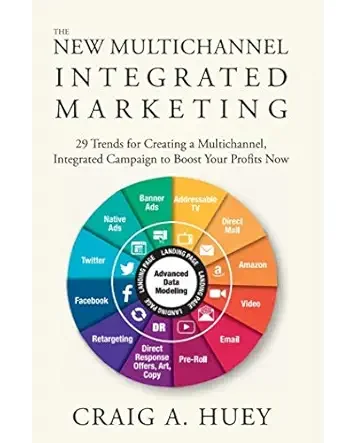
29 Trends for Creating a Multichannel, Integrated Campaign to Boost Your Profits Now
by Craig A. Huey
The 60-Second Take
In The New Multichannel, Integrated Marketing, direct-response expert Craig Huey makes the case that relying on any single marketing channel is a recipe for mediocre results. Today's customers move fluidly across email, social media, search, and direct mail, so marketers must integrate these channels into one coordinated, measurable system. Huey offers practical, response-driven strategies for reaching customers everywhere and tracking what actually works.
Why One Marketing Channel Is Never Enough Anymore
Not long ago, a business could pick a primary marketing channel, a newspaper ad, a direct mail piece, a radio spot, and build a steady stream of customers from it. Those days are gone. Craig Huey, a longtime direct-response marketing expert, argues in The New Multichannel, Integrated Marketing that today's customers are scattered across more channels than ever, and that reaching them requires a coordinated approach rather than a single bet. The book is a practical playbook for marketers who want measurable results in a fragmented landscape.
Huey writes from a direct-response tradition, meaning he cares less about awareness and image than about action: clicks, calls, leads, and sales you can actually track. His central message is that the channels themselves matter less than how well you integrate and measure them. This summary lays out the core themes, including why integration beats isolated tactics and why measurement is the discipline that separates winners from the rest.
What You'll Learn
Why single-channel marketing no longer delivers
What integrated, multichannel marketing actually means
How a direct-response mindset focuses you on results
Why testing and measurement are non-negotiable
How to reach customers consistently across channels
The End of the Single Channel
Huey's starting point is the reality that customer attention has fragmented. People research on search engines, scroll social media, open some emails, ignore others, check the mail, and respond to different messages in different contexts. No single channel reaches all of your potential customers, and even the ones it does reach are also being influenced by everything else they encounter. Betting your marketing on one channel leaves most of your audience untouched and your results fragile.
The implication is that marketers must meet customers across multiple channels rather than hoping one will carry the whole load. But Huey is careful to distinguish this from simply being everywhere at once. Scattering disconnected messages across many channels is not a strategy. The goal is not just more channels but a deliberate combination of them, chosen and coordinated to reinforce one another rather than compete for attention or budget.
Integration Is the Real Point
The heart of the book is the idea of integration. A multichannel effort works only when the channels are woven together into a coherent system, with consistent messaging and a unified sense of who the customer is and what action you want them to take. An email campaign should reinforce what someone sees on social media, which should connect to the experience they have on your website or with a direct mail piece. Each touch builds on the others, so the whole becomes greater than the sum of its parts.
Huey emphasizes that integration is both a creative and an operational challenge. The messaging must be consistent across channels, and the systems behind them must share information so the right people see the right message at the right time. Done well, integration means a prospect experiences a seamless story no matter where they encounter your brand, which is far more persuasive than a series of disconnected ads that happen to share a logo.
Huey's Core Principles at a Glance
Single channels fail. Fragmented attention means no one channel reaches your whole audience.
Combine deliberately. Choose and coordinate channels so they reinforce each other.
Integrate the message. Keep messaging and customer understanding consistent across every touchpoint.
Demand a response. Focus on trackable actions like leads and sales, not just awareness.
Test and measure. Let data, not opinion, decide what stays and what goes.
The Direct-Response Discipline of Measurement
What grounds Huey's approach is the direct-response philosophy of measuring everything. Unlike brand advertising that hopes to build vague awareness, direct-response marketing is built to generate trackable actions and to know exactly what each effort produced. This mindset turns marketing from guesswork into something closer to a science, where every campaign is an experiment and every result is data you can learn from.
Huey stresses testing as the engine of improvement. Rather than committing a large budget to an unproven idea, the disciplined marketer tests variations, headlines, offers, channels, audiences, measures the response, and scales what works while cutting what does not. Over time, this relentless testing and measurement compounds into a marketing system that keeps getting more efficient. The marketers who win, in his view, are not necessarily the most creative but the most rigorous about learning from real results.
A Quick Start Guide to Integrated Marketing
Map your customer's channels. Identify where your audience actually spends attention, not where you assume.
Coordinate, don't scatter. Choose a deliberate mix of channels and connect them around one message.
Unify your message. Keep your offer and story consistent so every touchpoint reinforces the others.
Build in a response. Give every campaign a clear, trackable action you want the customer to take.
Test relentlessly. Run small experiments, measure the results, and scale only what proves itself.
Final Reflections
The New Multichannel, Integrated Marketing is a useful, practical guide for business owners and marketers trying to make sense of an increasingly crowded and fragmented landscape. Its strength lies in pairing a clear strategic message, that integration across channels beats isolated tactics, with the rigorous, results-focused discipline of direct response. Readers looking for the latest platform-specific hacks should look elsewhere, but those who want durable principles for coordinating and measuring their marketing will find plenty to apply. For anyone responsible for generating leads and sales rather than just impressions, it is a grounded reminder that coordination and measurement, not any single channel, are what drive results.
The Bottom Line
No single channel can carry your marketing anymore, so the businesses that win are the ones that integrate many channels into one coordinated, relentlessly measured system built around real customer response.
Business Floss is reader-supported. When you use our links we may earn an affiliate commission that helps us keep the site running. Thank you for your support!