
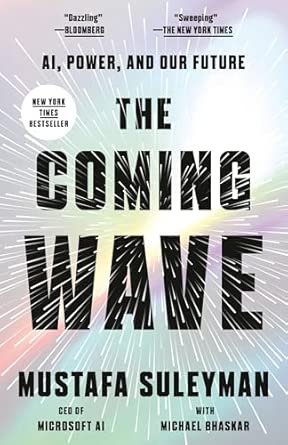
The Coming Wave
AI, Power, and Our Future
by Mustafa Suleyman & Michael Bhaskar
The 60-Second Take
In The Coming Wave, DeepMind co-founder Mustafa Suleyman warns that converging technologies including AI, synthetic biology, and quantum computing will reshape society on a scale humanity has not previously contained. The book explores the "containment problem" of preventing catastrophe while still capturing the benefits. A sobering and serious treatment of where the technology curve actually leads.
The Coming Wave: The Containment Problem of the Next Decade
Most books about emerging technology are written by either evangelists or critics. Mustafa Suleyman is unusual in that he sits inside the technology and writes about it with both deep credibility and visible alarm. As a co-founder of DeepMind, the AI lab that Google acquired and that produced AlphaGo and AlphaFold, Suleyman helped build the technology he now writes about. He went on to start Inflection AI and later joined Microsoft as the head of its consumer AI work.
The Coming Wave: AI, Power, and Our Future, co-written with Michael Bhaskar, is Suleyman's attempt to describe what is actually coming and what it might do. The book is more sobering than optimistic. The central concept is what the authors call the containment problem: the difficulty of preventing the most consequential failure modes of a technology while still capturing its benefits.
What You'll Learn
The convergence of multiple powerful technologies, including AI and synthetic biology
The four features that make this wave especially difficult to contain
Specific scenarios for both beneficial and catastrophic outcomes
The authors' proposals for governance and risk management
Practical implications for individuals, companies, and policymakers
The Convergence
The book opens with the observation that we are not facing a single technology revolution but several at once. The four most consequential.
Artificial intelligence. Large language models, computer vision, robotics, and increasingly general systems that can perform many cognitive tasks at human or above-human level.
Synthetic biology. Tools to design, edit, and produce biological systems. CRISPR. Synthetic genomics. Engineered organisms.
Quantum computing. Still emergent but with the potential to break current cryptographic systems and enable new categories of computation.
Robotics and energy. Cheaper, more capable physical machines combined with abundant clean energy.
Each technology alone would be transformative. The convergence is more than additive. The technologies amplify each other in ways that make the combined trajectory steeper than any single curve.
The Four Features
Suleyman argues that this wave is especially hard to contain because of four specific features.
Asymmetry. A single individual or small group can now produce effects that previously required nation-states. A laptop and an internet connection can disrupt power grids. A modest biological lab can engineer pathogens.
Hyper-evolution. The technologies improve rapidly through feedback loops between research, deployment, and reinvestment. The pace of change continues to accelerate.
Omni-use. Each technology has so many applications, beneficial and harmful, that restricting access is enormously difficult.
Autonomy. Increasingly the systems can act independently of human direction. AI agents can plan and execute multi-step actions. Biological systems can self-replicate.
These features combine to produce what Suleyman calls the containment problem. Previous transformative technologies had at most two or three of these properties. The current wave has all four simultaneously.
What Could Go Wrong
The book is concrete about specific scenarios.
Engineered pandemics. As biological engineering becomes cheaper and more widespread, the risk of deliberate or accidental release of dangerous pathogens rises sharply.
AI-driven manipulation. Personalized propaganda, scaled deepfakes, and automated influence operations could destabilize democracies.
Cyber attacks. AI-augmented attacks on infrastructure could cause cascading failures in power, water, finance, or communications.
Autonomous weapons. Systems that can identify and engage targets without human judgment in the loop, deployed by states or non-state actors.
Economic concentration. The most capable systems require enormous capital, which could concentrate economic power in a small number of firms or countries.
Suleyman is not predicting these outcomes. He is mapping the space of plausible futures and arguing that the current trajectory does not adequately address them.
What Could Go Right
The book is balanced about the upside. The same technologies that produce risk also produce extraordinary benefits.
Medicine. Faster drug discovery, personalized treatment, better diagnostics, and reduced cost of care.
Climate. Cheaper clean energy, better materials, and atmospheric carbon capture.
Productivity. Massive gains in cognitive labor that could free human time for higher-value work.
Education. Personalized tutoring at scale could improve learning outcomes globally.
The authors' point is not that the technology is bad. It is that the same power that enables benefits also enables harms, and that managing the trade-off requires deliberate effort that is not happening at scale.
The Containment Proposal
Suleyman outlines a multi-layered approach to containment.
Technical safety. Build the technologies themselves with safety features. Alignment research for AI. Biosecurity protocols. Defense-in-depth in cyber systems.
Audits and standards. Independent testing, certification, and disclosure regimes for high-impact systems.
International coordination. Agreements between major powers to limit specific applications, similar in spirit to nuclear non-proliferation treaties.
Government capacity. Regulatory agencies with the talent and authority to oversee the most powerful systems.
Corporate responsibility. Internal governance, red-teaming, and accountability mechanisms within the firms building the technology.
The author is realistic that none of these alone is sufficient. The proposal is a multi-layered defense, each layer imperfect, that collectively reduces the risk of catastrophic failure.
What Operators and Investors Should Take Away
The book is most useful to working professionals in a few specific ways.
The technology is moving faster than your business plan assumes. Capital allocation decisions made on a 5-year horizon may be obsolete in 2.
Regulatory regimes will shift dramatically. New rules, often imposed quickly after a high-profile incident, will reshape compliance costs and competitive positioning.
Concentration risk is rising. A small number of firms control the most capable AI systems. Dependence on any one of them is a strategic question.
Talent will be the constraint. The few thousand people in the world who can build the most advanced systems are the actual bottleneck.
Reputation is now a tail risk. Companies that misuse powerful technology face faster and more severe public consequences than they did a decade ago.
A Quick Start Guide
Apply this lens to your own work.
Map your AI exposure. Both as user and as competitor. Where in your business does AI capability change the cost structure or competitive set?
Audit your tail risks. Cybersecurity, supply chain dependency on AI providers, regulatory shifts. Build scenarios for each.
Engage with governance. Whether through industry groups, public comments on regulation, or internal policy, the rules being set in the next few years will shape the next decade.
Invest in human capital. The skills that complement AI capabilities are the ones most likely to retain value.
Pay attention to the safety conversation. It is not academic. It is shaping real business and policy decisions.
Final Reflections
The Coming Wave is unusually credible because the author has helped build the technology he is now warning about. Suleyman is not a critic from outside the industry. He is someone who has seen what is being built and concluded that the current governance is inadequate to the moment. The book is sobering without being apocalyptic. The proposals are serious without being naive about their difficulty. For finance professionals, operators, and citizens trying to make sense of the current technology trajectory, this is one of the more important books of recent years.
Business Floss is reader-supported. When you use our links we may earn an affiliate commission that helps us keep the site running. Thank you for your support!