
Creativity, Inc.
Good to Great
Building a Second Brand
The Lean Startup
Blue Ocean Strategy
Leaders Eat Last
The Innovator's Dilemma
Thinking, Fast and Slow
Lean In
The Power of Habit
Four Thousand Weeks
The 5AM Club
Crucial Conversations
The Infinite Game
Never Split the Difference
The First 90 Days
Creativity, Inc. Good to Great Building a Second Brand The Lean Startup Blue Ocean Strategy Leaders Eat Last The Innovator's Dilemma Thinking, Fast and Slow Lean In The Power of Habit Four Thousand Weeks The 5AM Club Crucial Conversations The Infinite Game Never Split the Difference The First 90 Days
Keep your mind fresh with summaries of the best business books

Built To Last
In Built to Last, Jim Collins and Jerry I. Porras present the results of a six-year Stanford University study answering one question: what makes truly exceptional companies outlast their peers? Comparing visionary organizations with their closest rivals, the authors dismantle the myth of the charismatic founder. Enduring greatness, they prove, requires a fierce dedication to core values, massive audacious goals, and an architectural obsession with building systems over launching products.

Discipline Is Destiny
In Discipline is Destiny, Ryan Holiday explores the ancient Stoic virtue of temperance. Drawing on historical figures like Queen Elizabeth II, Lou Gehrig, and Marcus Aurelius, Holiday argues that self-control is not a restriction, but the ultimate source of personal freedom. By mastering the physical body, regulating the mind, and elevating the soul, readers learn how to build the iron-clad habits required to achieve enduring greatness and avoid self-destruction.

Competing For The Future
In Competing for the Future, strategy experts Gary Hamel and C.K. Prahalad dismantle the corporate obsession with downsizing and restructuring. They argue that cutting costs only makes an organization thinner, not healthier. To dominate tomorrow's markets, leaders must develop industry foresight, build a portfolio of core competencies, and pursue a massive strategic intent. It is a timeless blueprint for inventing new industries rather than playing endless catch-up in existing ones.

The Infinite Game
In The Infinite Game, Simon Sinek applies the philosophical framework of finite and infinite play to the business world. He argues that leaders who try to "win" their industries end up destroying trust, stifling innovation, and driving their companies into the ground. By mastering five essential practices—including advancing a Just Cause, building Trusting Teams, and studying worthy rivals—leaders can build resilient organizations designed to outlast their competitors and thrive for generations.

Turn the Ship Around!
In Turn the Ship Around!, former Navy Captain L. David Marquet shares how he transformed the worst-performing submarine in the fleet into its absolute best. By abandoning the traditional top-down chain of command for a "leader-leader" model, he proves that true excellence comes from pushing decision-making power down the ranks. It is a practical, brilliant blueprint for replacing passive compliance with active, intent-based ownership.

Creativity, Inc.
In Creativity, Inc., Pixar co-founder Ed Catmull reveals the management philosophy behind the studio's unprecedented success. He argues that creativity is not a mystical event but a team process that can be managed by building a culture of trust and candor. Using concepts like the "Braintrust" for honest feedback and protecting new "ugly baby" ideas from fear, Catmull provides a playbook for any leader looking to overcome the hidden forces that stifle innovation and build a fearless, creative organization.

The Five Dysfunctions of a Team
The Five Dysfunctions of a Team is Patrick Lencioni's model of why teams underperform, presented mostly as a fable about a new CEO inheriting a dysfunctional executive group. His five dysfunctions form a pyramid: absence of trust at the base, then fear of conflict, lack of commitment, avoidance of accountability, and inattention to results at the top. The sequence is the point, since each one is produced by the one below it, which means visible symptoms almost always trace to a foundation problem nobody is addressing.

Dare to Lead
In Dare to Lead, Brené Brown uses extensive research to argue that leadership is not about power or control, but about the courage to be vulnerable. She outlines four teachable skills for "daring leadership": rumbling with vulnerability, living into your values, building trust through her "BRAVING" framework, and learning to rise from failure. The book is a practical playbook for any leader looking to build more courageous, empathetic, and innovative teams by shedding their professional "armor."
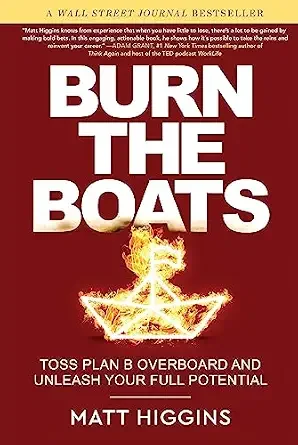
Burn the Boats
In Burn the Boats, Matt Higgins argues that having a "Plan B" is a recipe for mediocrity. He uses the ancient military tactic of burning one's ships to illustrate how eliminating the option of retreat forces total commitment and unleashes one's full potential. This mindset isn't about reckless risk, but about making a calculated, all-in decision after due diligence. By removing your safety net, you unlock the desperate creativity required for breakthrough success.

The Hard Thing About Hard Things
In The Hard Thing About Hard Things, Ben Horowitz provides a brutally honest guide to the challenges of entrepreneurship that business schools don't cover. He argues that "The Struggle" is an inevitable part of the journey and introduces critical concepts like the Peacetime vs. Wartime CEO. Offering no easy answers, Horowitz gives unfiltered advice on difficult tasks like firing friends and managing your own psychology, making this an essential read for any leader navigating chaos.

Leaders Eat Last
Simon Sinek's argument starts with a Marine Corps custom, officers eating after their troops, and builds it into a theory of why some workplaces produce loyalty and others produce quiet self-protection. His central idea is the Circle of Safety: when people trust that leadership will absorb risk on their behalf, they stop guarding against threats from inside the organization and turn their energy outward. Sinek grounds this in the neurochemistry of endorphins, dopamine, serotonin and oxytocin, argues that most modern workplaces have become dopamine-heavy and trust-poor, and names the imbalance Destructive Abundance. The conclusion is that protecting people is not the reward for performance but the precondition for it.

The Ride of a Lifetime
In The Ride of a Lifetime, former Walt Disney Company CEO Bob Iger reflects on fifteen years leading the world’s most powerful entertainment brand. Blending personal memoir with a practical masterclass in leadership, he details the high-stakes negotiations behind acquiring Pixar, Marvel, and Lucasfilm. Iger proves that sustaining a creative empire requires radical focus, enduring optimism, and a willingness to embrace disruption rather than fight it.

The Innovator's Dilemma
In The Innovator's Dilemma, Clayton M. Christensen explains why outstanding companies lose their market leadership despite doing everything right. He reveals that the very practices of good management—listening to customers and focusing on high-margin products—blind incumbents to disruptive technologies. By analyzing industries like steel and disk drives, Christensen provides a structural framework for recognizing disruptive threats and creating the organizational space required to survive them.