Ambition Without the Burnout
Gino Wickman knows how to build businesses. He created the Entrepreneurial Operating System (EOS), the management framework behind Traction, which has been adopted by a very large number of small and midsize companies. He also knows what it costs to push too hard.
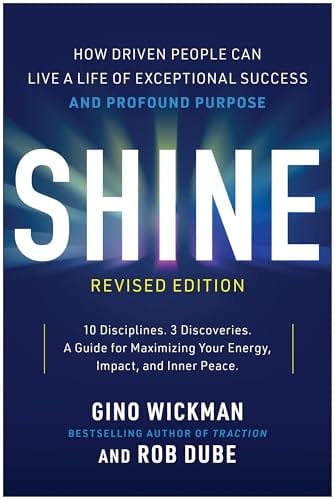
Shine, written with Rob Dube, a longtime entrepreneur, meditation practitioner, and Wickman's podcast co-host, is the result of that experience. Originally published in 2024 with a subtitle aimed squarely at entrepreneurs, it was reissued in a revised edition in 2026 as Shine: How Driven People Can Live a Life of Exceptional Success and Profound Purpose. The book argues that driven people do not need to choose between ambition and peace of mind. This summary covers the authors' stories, the book's three foundational discoveries, its 10 disciplines, and who is most likely to benefit.
What You'll Learn
- Why many driven leaders lack awareness of habits that undermine their success and well-being
- How Wickman and Dube distinguish decisions made from love versus fear
- The 10 disciplines they recommend for managing energy, focus, and impact
- How to use the book's self-assessments to track progress over time
- Where the advice fits best and where it may be hard to apply
Two Driven Founders Who Hit a Wall
The book draws heavily on its authors' own stories. Wickman describes a turbulent early career before he helped turn around and eventually sell his family's business. He went on to create EOS in 2000 and spent years teaching it to entrepreneurs, until health problems linked to overwork forced him to change how he lived and worked.
Dube's path runs parallel. A lifelong entrepreneur, he led the company imageOne, sold it, later bought it back, and eventually handed day-to-day leadership to a successor. Along the way, he faced serious personal challenges and found help through therapy, meditation, and journaling, practices that now anchor much of the book. Today he leads an organization built around the book's disciplines and co-hosts a podcast with Wickman.
Their shared conclusion is that the same intensity that builds companies can quietly erode health, relationships, and judgment if it goes unexamined. Shine is their attempt to give other driven people a way to keep the intensity while losing the damage.
The Three Discoveries
The first part of the book lays out three discoveries that frame everything that follows.
Driven people often lack awareness. Wickman and Dube observe that many high achievers are so focused on goals that they barely notice the patterns driving them. Their minds are constantly racing, they are physically present but mentally absent with family and friends, and they may not see how early experiences shaped habits like overwork. Becoming aware of these patterns is the first step toward changing them.
Decisions come from love or fear. In the book's longest chapter, the authors argue that many choices are driven either by love, meaning a sense of security, purpose, and generosity, or by fear, which they connect to an overactive ego. Fear can be a powerful short-term motivator, they suggest, but over time it narrows thinking and drains energy. They encourage readers to notice which emotion is behind their decisions and to reduce the ego's grip by reconnecting with what they call the True Self, an authentic core beneath layers of habit and experience.
You can be driven and at peace. The third discovery is the book's central promise. Using examples from Dube's experience running his company, the authors argue that ambition and calm can coexist. Peace of mind does not require giving up big goals; it can make people more creative, focused, and effective in pursuing them.
The 10 Disciplines, Part One: Perspective and Self-Knowledge
The second part of the book presents 10 disciplines meant to put those discoveries into practice. Several focus on perspective and self-understanding.
- 10-Year Thinking. Instead of operating only in the present or the current year, set a long-term vision. Thinking in decades reduces short-term anxiety and helps clarify what really matters.
- Take Time Off. Fully disconnect from work for meaningful periods. The authors argue that stepping away allows the mind to settle and often leads to clarity and fresh ideas.
- Know Thyself. Use tools like talk therapy and personality assessments, such as Myers-Briggs, DiSC, and the Enneagram, to understand your tendencies, strengths, and blind spots.
- Be Still. Build a regular practice of meditation, contemplation, prayer, or journaling. This discipline reflects Dube's long experience with meditation and is central to the book's message about reducing mental noise.
The 10 Disciplines, Part Two: Boundaries and Focus
The remaining disciplines are more tactical and will feel familiar to readers of Wickman's earlier work.
- Know Your 100%. Identify the number of hours and weeks you can work at your best, and plan around that capacity rather than working without limits.
- Say No Often. Protect your time by declining meetings, requests, and commitments that do not align with your priorities.
- Don't Do $25-an-Hour Work. Delegate administrative and low-value tasks so you can focus on work where you add the most value.
- Prepare Every Night. Before going to bed, write out a plan for the next day. This clears your mind and helps you start the day with focus.
- Put Everything in One Place. Capture ideas, commitments, and tasks in a single trusted system so nothing slips through the cracks.
- Be Humble. Shift attention away from yourself and toward others, which the authors see as an antidote to ego-driven decisions. Each section ends with a summary and a self-assessment, asking readers to rate statements on a scale from one to five. The authors intend the book to be revisited as a workbook, with readers gradually adopting more disciplines over time rather than implementing everything at once.
The Ten Disciplines at a Glance
- Inner work supports outer results. Self-awareness and stillness can improve focus and decision-making, not just well-being.
- Capacity has limits. Knowing your sustainable workload prevents burnout and improves quality.
- Boundaries create freedom. Saying no and delegating protect time for high-impact work.
- Progress is gradual. The disciplines are meant to be built over time, not adopted overnight.
A Quick Start Guide to Applying Shine
- Take the self-assessment. Rate yourself on each discipline and pick the one or two with the lowest scores to start.
- Set a stillness practice. Begin with a few minutes of meditation, journaling, or quiet reflection each morning.
- Define your 100%. Estimate the hours per week you can work at your best and identify one change to stay within that limit.
- Plan tomorrow tonight. Spend five minutes each evening writing down the next day's priorities.
- Schedule real time off. Put a fully disconnected break on your calendar and protect it as you would a client meeting.
Who Should Read Shine (and Who Can Skip It)
- Read it if you are an entrepreneur or executive who feels constantly busy, mentally scattered, or on the edge of burnout.
- Read it if you use EOS or have read Traction and want a personal companion focused on the leader rather than the business.
- Read it if you are curious about meditation and self-awareness but want a practical, business-friendly introduction.
- Skip it if you have limited control over your schedule. Advice about knowing your 100%, taking extended time off, and delegating $25-an-hour work assumes a level of autonomy many employees do not have.
- Skip it if you want research-based guidance on burnout or well-being. The book relies mostly on the authors' experiences and is light on evidence.
Final Reflections
Shine addresses a real problem with sincerity. Many driven leaders struggle with racing minds, blurred boundaries, and the sense that peace and success are incompatible. Wickman and Dube offer a practical path forward, and the 10 disciplines are clear, actionable, and easy to revisit. The combination of inner work, such as stillness and self-awareness, with concrete habits like nightly planning and delegation is the book's main strength.
Its limitations are worth noting. Much of the advice is drawn from the authors' own experiences, and the book offers little scientific evidence for its claims about ego, fear, and performance. Several disciplines, such as taking long breaks and refusing low-value work, are far easier for founders and senior leaders than for people with less control over their time, and the book does not fully address that gap. Some readers may find the spiritual language around the True Self and love versus fear vague or unfamiliar in a business book. Rob Dube also leads a company built around the 10 Disciplines, and the book naturally serves as an introduction to that work. Read it as a thoughtful starting point and adapt the disciplines to your own circumstances.
The Bottom Line
Ambition and peace of mind can coexist, but only if you build deliberate habits, like stillness, boundaries, and real time off, that keep your drive from running your life.
Frequently Asked Questions
What are the 10 disciplines in Shine?
They are 10-Year Thinking, Take Time Off, Know Thyself, Be Still, Know Your 100%, Say No Often, Don't Do $25-an-Hour Work, Prepare Every Night, Put Everything in One Place, and Be Humble. Together, they aim to help driven people manage energy and focus while maintaining inner peace.
What does "Know Your 100%" mean?
It means identifying the number of hours and weeks you can work at your best before quality and energy decline. Wickman and Dube encourage readers to plan around that capacity instead of treating unlimited work as the default.
Do I need to use EOS to benefit from Shine?
No. While Wickman created EOS and some advice will feel familiar to EOS users, Shine focuses on the individual leader's habits and mindset. Its disciplines can be applied regardless of how your business is managed.