The Internet Didn't Repeal Economics
In the late 1990s, it was fashionable to say the internet had created a "new economy" where old business rules no longer applied. Carl Shapiro and Hal Varian, two economists at the University of California, Berkeley, disagreed. Their argument was simple: technology changes, but economic laws do not.
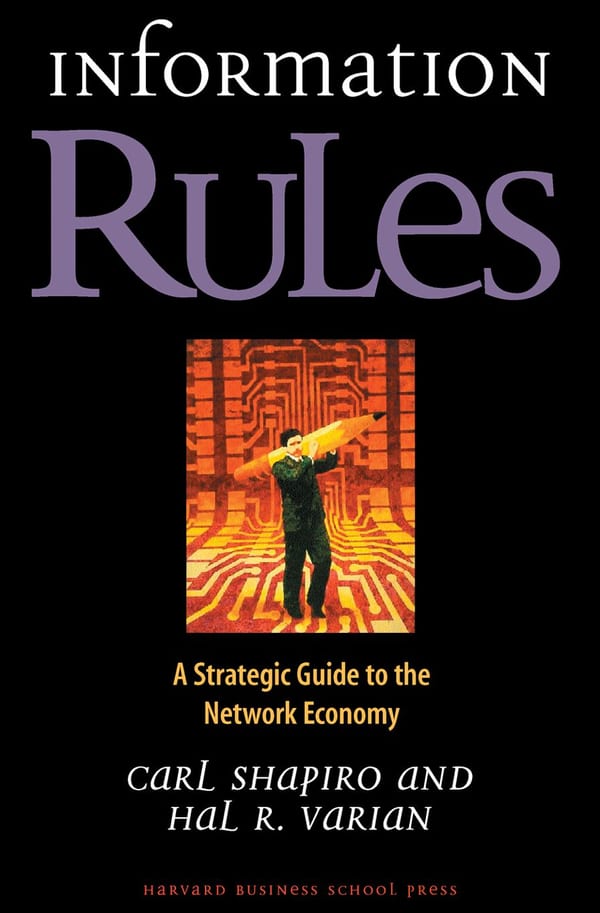
Information Rules: A Strategic Guide to the Network Economy (1998) set out to prove it. Shapiro, a business strategy professor who also served in senior antitrust roles in the U.S. government, and Varian, who later became chief economist at Google, translated decades of economic research on pricing, switching costs, and network effects into practical advice for managers. This summary covers the economics of information goods, pricing and versioning, lock-in, network effects and standards wars, and how well the book holds up.
What You'll Learn
- Why information goods have unusual costs and how that should change pricing
- How versioning and Goldilocks pricing capture value from different customer types
- What switching costs and lock-in mean, and how to manage them from both sides
- Why network effects create positive feedback and winner-take-most markets
- How companies win standards wars through alliances, timing, and expectations
The Strange Economics of Information Goods
The book starts with the cost structure of information. Producing the first copy of a piece of software, a database, an encyclopedia, or a film can be enormously expensive. Producing the second copy is almost free. High fixed costs and near-zero marginal costs change the rules of competition.
When copies cost nothing, competition can push prices toward zero, which makes cost-based pricing a trap. Shapiro and Varian argue that companies selling information must price according to the value customers place on it, not what it costs to make. They also stress that information is an "experience good": customers often have to try it to know whether it's worth paying for, which is why previews, samples, reviews, and brands matter so much.
The book's examples include the encyclopedia market, where cheap CD-ROM encyclopedias upended Encyclopædia Britannica's expensive, door-to-door business. The lesson was that a strong brand and quality product don't protect you if the economics of distribution change underneath you.
Pricing and Versioning: Charging Different Customers Differently
If information should be priced by value, and different customers value it differently, then the best strategy is to sell different versions at different prices. Shapiro and Varian call this versioning.
Companies can version products along many dimensions, such as speed, features, convenience, image resolution, timeliness, or support. Professionals who need real-time data pay more than casual users who can wait. Power users pay for advanced features that most customers don't need. The goal is to design versions that lead customers to sort themselves by how much they value the product.
The authors also describe a practical rule often called Goldilocks pricing: when in doubt, offer three versions. Many customers avoid extremes and choose the middle option, which lets a company steer buyers toward a target tier while still serving those at the low and high ends. Anyone who has seen "Basic, Pro, and Enterprise" plans has seen this idea in action.
The book also covers personalized pricing and bundling, both of which use information about customers to match price to value more closely.
Lock-In and Switching Costs
One of the book's most influential ideas is lock-in. When customers invest in a technology, through training, data, compatible equipment, contracts, or habits, switching to a competitor becomes expensive. Those switching costs give the incumbent supplier pricing power.
Shapiro and Varian describe a lock-in cycle: a company competes to win a customer, the customer commits and builds up switching costs, and the supplier then earns returns from that installed base. Lock-in is common in software, hardware, telecom, and enterprise systems.
They treat lock-in from both sides:
- For sellers: it can be worth investing heavily, even at a loss, to acquire customers who will generate profits later. The value of a customer includes the switching costs you can capture.
- For buyers: recognize lock-in before you commit. Negotiate protections up front, avoid dependence on a single supplier, and insist on compatibility or data portability where possible.
Network Effects, Positive Feedback, and Standards Wars
The second half of the book focuses on network effects: products that become more valuable as more people use them. Telephones, fax machines, operating systems, and online platforms all work this way. Network effects create positive feedback, where the strong get stronger and the weak get weaker, so markets often tip toward a single winner.
That makes expectations critical. If customers believe a technology will win, they adopt it, which helps it win. So alongside product quality, companies compete to convince the market they will become the standard.
When incompatible technologies compete, the result is a standards war. Drawing on more than a century of examples, from early electrical systems to video formats and modems, Shapiro and Varian identify the assets that matter in these battles, including control over an installed base, intellectual property, ability to innovate, first-mover advantages, manufacturing strength, complementary products, and brand. They recommend three key tactics: building alliances, exploiting first-mover advantages, and managing consumer expectations.
They also discuss when to cooperate rather than fight. Sometimes the best move is to join or create an open standard, accepting a smaller share of a much larger market rather than risking a destructive war.
The final chapter turns to policy, including antitrust and intellectual property, and how governments should think about dominant firms in network markets.
Information Rules at a Glance
- Value-based pricing: pricing information according to what customers will pay, since the cost of a copy is close to zero.
- Versioning: offering multiple versions so customers sort themselves by how much they value the product.
- Lock-in: the pricing power that comes from customers' switching costs.
- Common misconception: that network effects guarantee permanent dominance. Expectations, alliances, and new technologies can still shift who wins.
A Quick Start Guide to Applying Information Rules
- Price by value, not cost. Interview customers about the outcomes your product creates and set prices around that value.
- Design three tiers. Build basic, standard, and premium versions that differ on dimensions your best customers care about most.
- Map switching costs. List what your customers would lose by leaving, and what you'd lose by leaving your key vendors.
- Protect yourself as a buyer. Before signing a long-term technology contract, negotiate data portability, exit terms, and price protections.
- Manage expectations deliberately. If your product depends on network effects, invest in partnerships, early adopters, and visible momentum.
Who Should Read Information Rules (and Who Can Skip It)
- Read it if you work in software, media, data, or platform businesses and want the economic logic behind pricing tiers, lock-in, and network effects.
- Read it if you're a strategist or investor who wants a rigorous foundation for ideas often reduced to buzzwords, such as moats and platform effects. It pairs well with the monopoly arguments in Zero to One.
- Skip it if you want modern case studies. Most examples come from the 1990s and earlier.
- Skip it if you already know basic industrial organization economics. Much of the book will feel familiar, if very clearly explained.
Final Reflections
Information Rules has aged far better than most books written during the dot-com boom. Its core frameworks, value-based pricing, versioning, lock-in, network effects, and standards wars, describe how software subscriptions, app stores, cloud platforms, and online marketplaces still work. The writing is clear and practical, and the authors avoided the hype of the era by grounding their advice in established economics rather than predictions. Readers who enjoyed the economics of digital distribution in The Long Tail will find a more rigorous foundation here.
It has real limitations, though. The examples are dated: fax machines, modems, CD-ROMs, and 1990s browser wars dominate the cases, so readers have to translate the lessons to today's markets themselves. The book was written before smartphones, social networks, cloud computing, and ad-supported platforms reshaped the industry, and it says relatively little about data as a business model, free products funded by advertising, or multi-sided platforms. Some reviewers also noted that it is written largely from the producer's point of view, with limited attention to the consumer and public interest concerns raised by lock-in and dominant networks.
Read it as a durable economic toolkit for digital strategy, and expect to supply your own modern examples.
The Bottom Line
Digital products change constantly, but the economics underneath them, value-based pricing, switching costs, and network effects, still decide who wins.
Frequently Asked Questions
What is versioning?
Versioning means offering an information product in several forms at different prices, such as basic, professional, and enterprise editions. Shapiro and Varian argue it lets companies capture more value by letting customers choose the version that matches how much they value the product.
What is lock-in?
Lock-in occurs when switching costs, such as training, data migration, compatible equipment, or contracts, make it expensive for customers to change suppliers. It gives the incumbent pricing power, so the authors advise buyers to recognize and limit lock-in before committing.
Are the book's ideas still relevant today?
Largely, yes. Pricing tiers, platform lock-in, network effects, and standards battles remain central to software and internet businesses. The specific examples are dated, and newer issues such as ad-supported platforms and data-driven business models get limited coverage.