
Creativity, Inc.
Good to Great
Building a Second Brand
The Lean Startup
Blue Ocean Strategy
Leaders Eat Last
The Innovator's Dilemma
Thinking, Fast and Slow
Lean In
The Power of Habit
Four Thousand Weeks
The 5AM Club
Crucial Conversations
The Infinite Game
Never Split the Difference
The First 90 Days
Creativity, Inc. Good to Great Building a Second Brand The Lean Startup Blue Ocean Strategy Leaders Eat Last The Innovator's Dilemma Thinking, Fast and Slow Lean In The Power of Habit Four Thousand Weeks The 5AM Club Crucial Conversations The Infinite Game Never Split the Difference The First 90 Days
Keep your mind fresh with summaries of the best business books

Getting Things Done
Getting Things Done is David Allen's system for managing commitments so they stop consuming attention. Its premise is that the mind is for having ideas rather than holding them, and that every unfinished obligation stored mentally drains focus regardless of whether you can act on it. The method runs in five steps — capture, clarify, organize, reflect, engage — anchored by two disciplines that do most of the work: defining the specific next physical action for everything, and a weekly review that keeps the whole system trustworthy.

The Book of Boundaries
In The Book of Boundaries, Melissa Urban provides a practical guide to setting limits that will set you free from burnout and resentment. She argues that clear, kind boundaries are essential for healthy relationships. The book offers a color-coded framework (Green, Yellow, Red) for escalating your boundaries and provides word-for-word scripts for common situations at work and home. Urban’s core message is that being direct and clear is an act of kindness that protects your time, energy, and mental health.

The Four Hour Workweek
The 4-Hour Workweek by Timothy Ferriss is a manifesto for escaping the 9-to-5 grind by re-engineering your life and work. Using the "DEAL" framework (Definition, Elimination, Automation, Liberation), Ferriss provides a blueprint for maximizing output in minimum time. By applying principles like the 80/20 rule and Parkinson's Law, creating automated "muse" businesses for passive income, and negotiating remote work, the book argues you can achieve a lifestyle of freedom and "mini-retirements" now, not later.

The Go-Giver
The Go-Giver by Bob Burg and John David Mann is a business parable that argues the secret to success is giving, not taking. It introduces the Five Laws of Stratospheric Success, which teach that true worth comes from providing more in value than you receive in payment. By focusing on value, serving more people, placing others' interests first, being authentic, and staying open to receiving, individuals can achieve extraordinary results.

Lean In
In her influential book Lean In, Sheryl Sandberg urges women to combat the internal barriers holding them back in the workplace. She argues that women should "sit at the table" by speaking up, owning their ambition, and fighting impostor syndrome. Sandberg provides a compelling framework for navigating career challenges, from avoiding the trap of "leaving before you leave" to the necessity of making your partner a true partner at home.
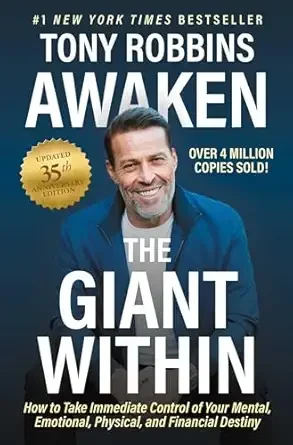
Awaken the Giant Within
In Awaken the Giant Within, Tony Robbins lays out a 544-page system for changing behavior on purpose: pain and pleasure as the engine, beliefs built on references, and the personal rules that quietly decide whether you ever feel satisfied. Overclaimed in places and unmistakably a seminar in book form, it still contains ideas that have outlasted most of the genre.

The Happiness Advantage
In The Happiness Advantage, Harvard researcher Shawn Achor argues the success formula most of us run is backwards. Happiness is not the prize waiting at the end of hard work; it is the fuel that makes the work go better. Across seven principles, from the Tetris Effect to the Zorro Circle to the 20-Second Rule, he shows how small mindset and habit shifts compound into real performance gains.

The 5AM Club
In The 5 AM Club, leadership expert Robin Sharma uses a narrative fable to present a comprehensive system for mastering your morning. He argues that waking up at 5:00 a.m. offers a distraction-free window to optimize your mind, body, and spirit. By applying structured routines like the 20/20/20 Formula and cultivating four interior empires, you can build lasting habits and dramatically increase your daily output.

Thinking, Fast and Slow
In Thinking, Fast and Slow, Nobel laureate Daniel Kahneman provides a masterclass in human irrationality. He reveals that our minds operate on two systems: one fast, intuitive, and prone to hidden biases, the other slow, logical, and incredibly lazy. By exposing the predictable mental shortcuts we take, Kahneman offers a profound framework for making better decisions in business and life while recognizing the limits of our own objectivity.