You Cannot Sell What You Wouldn't Buy
Zig Ziglar's central claim is that selling is a transference of feeling. You are moving your own conviction about the product into the other person, and you cannot transfer a feeling you don't have.
He puts it in a line built around the word itself: take the C out of close and you're left with lose, and the C stands for conviction. Corny, memorable, and pointing at something real. Ziglar accepts that a salesperson can occasionally talk someone into a purchase they don't believe in. His argument is that this doesn't sustain a career, because the absence of belief registers with the buyer even when neither party can name what's wrong.
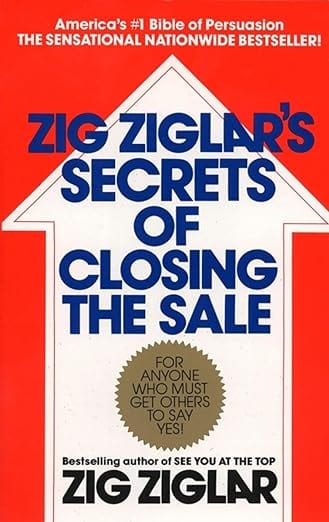
That's the spine of a very long book. Secrets of Closing the Sale runs to around four hundred pages, catalogs dozens of named closing techniques, and is soaked in the motivational register Ziglar built his career on. Published in the mid-1980s, it's simultaneously one of the more decent books about selling and one of the more dated.
What You'll Learn
- Why conviction functions as a technique rather than a nice-to-have
- What objections actually indicate, and why silence is worse
- How word pictures move a buyer from information to imagination
- The best-known named closes and what each is designed to do
- Where the tactical material has stopped working, and why
Selling as Service
Ziglar's framing of the profession runs underneath everything. Selling is not something done to a person; it's helping someone get what they want, and his best-known formula holds that you can have everything you want if you help enough other people get what they want.
He formalizes this as the salesperson acting as assistant buyer — sitting on the customer's side of the problem rather than opposite them — and packages the character requirements as an acronym: honesty, empathy, attitude, reserves, and tough love.
The test he returns to is the direct one. Would you buy this, at this price, in the customer's position? If not, the problem isn't your closing skills.
He also spends considerable space defending selling as a legitimate profession, tracing persuasion through history and arguing that the discomfort many people feel about sales work is misplaced when the product genuinely helps. For readers who find selling faintly embarrassing, this is the part that does the work.
Objections Are the Job
Ziglar's treatment of objections is the most immediately useful section and remains sound.
His position: an objection signals engagement. Someone raising a concern is thinking about buying. The prospect who agrees pleasantly with everything and offers no resistance is usually not a prospect at all. No objections generally means no interest.
The technique that follows is agreement rather than argument. Objections thrive on opposition and largely dissolve when met with agreement, so he starts by conceding the point, then reframes. On price, his structure is to accept that it costs more and pivot to why, since it's easier to explain price once than apologize for quality repeatedly.
He also distinguishes types. A logical objection gets answered emotionally; an emotional objection gets answered logically. And rather than assuming what someone means, ask: note that they clearly have a reason for feeling that way, and enquire what it is.
Underneath sits his broader rule that selling is asking, not telling. Questions uncover the real objection, involve the buyer in reaching their own conclusion, and prevent the presentation that answers concerns nobody had.
Word Pictures and the Closes
Two more mechanics carry the book.
Word pictures rest on the claim that people think in images rather than words. So rather than describing features, you place the buyer into a specific scene using the thing, in the present tense and in sensory detail. The related rule is that you sell what the product does, not what it is.
Then the closes, which is what the book is famous for. Dozens of them, each named and dramatized through a story. The Puppy Dog close lets someone take the product home with no commitment, on the theory that possession does the persuading. The Ben Franklin works through a written list of reasons for and against. The assumptive close proceeds as though the decision is made. The alternate of choice offers two ways to buy rather than a yes or no. Reduction to the ridiculous divides a large price into a trivial daily figure.
Each is genuinely a distinct psychological move rather than a rebranding of the same one, and the catalog is impressive as a piece of craft documentation.
Closing Techniques at a Glance
- Transference of feeling. Your conviction is the mechanism; without it, technique doesn't compensate.
- Assistant buyer. Positioning yourself alongside the customer rather than across from them.
- Objections as interest. Resistance signals engagement; agreeable silence usually signals none.
- Agreement over argument. Concede the point first, then reframe.
- Word pictures. Present-tense sensory scenes rather than feature descriptions.
- The named closes. Puppy dog, Ben Franklin, assumptive, alternate of choice, reduction to the ridiculous.
A Quick Start Guide to Closing Better
- Run the conviction test on your own product. Would you buy it at this price? An honest no explains more than any coaching would.
- Treat the next objection as good news. Agree with the concern before you address it and watch what happens to the temperature.
- Replace a feature with a scene. Describe the buyer using the thing rather than describing the thing.
- Ask instead of explaining. When you catch yourself presenting, convert the next three sentences into questions.
- Separate the no from yourself. Ziglar's point that rejection is a decision about the product at that moment, not a verdict on you, is what makes the job survivable.
Who Should Read Secrets of Closing the Sale (and Who Can Skip It)
- Read it if you're new to selling and find it uncomfortable. The material on selling as service is genuinely reassuring and mostly true.
- Read it if objections rattle you. That section alone will change how the next difficult conversation goes.
- Read it if you enjoy the motivational register. Ziglar is warm, funny, and completely sincere, and readers who click with him tend to reread him for decades.
- Skip it if you sell into enterprise accounts. The model assumes a single decision-maker in one conversation, and nothing here addresses buying committees, procurement, or a nine-month cycle.
- Skip it if the delivery will grate. It's long, repetitive, heavily anecdotal, and openly religious in places, and readers who want dense modern sales methodology will find it slow.
Final Reflections
The character half of this book has aged remarkably well. Conviction as a precondition, objections as engagement, questions over lectures, and rejection as information rather than judgment are all sound, and they're the parts working salespeople still quote forty years later. The insistence that selling is honourable when the product genuinely helps is more useful than it sounds, because the discomfort it addresses is what makes a lot of people bad at it.
The tactical half has aged much less well, and there's an internal tension the book never resolves.
The named closes were built for an era of information asymmetry, where the salesperson knew more about the product than the buyer and the conversation happened once, in person. Today's buyer has read the reviews, compared the pricing, and probably recognizes the assumptive close when it lands. Applying a scripted technique to someone who can see it working produces exactly the distrust Ziglar spends three hundred pages warning against.
That's the tension. Ziglar preaches sincerity, service, and honesty at length, and then supplies a catalog of psychological levers — including a few, like projecting an identity onto someone or making a theatrical withdrawal to trigger reversal, that are hard to square with the ethic he's arguing for. He'd say the techniques are legitimate when the product genuinely serves the buyer, and that's a coherent position. It also asks the salesperson to be the judge of that, in the moment, with a commission attached.
Take the character material seriously, use the questions and the objection handling, and be sparing with the closes.
The Bottom Line
Belief is the technique. If you'd buy it yourself at that price, most of the rest follows; if you wouldn't, no script will cover the gap.
Frequently Asked Questions
What does "selling is a transference of feeling" mean?
Ziglar's core claim that a sale happens when your genuine conviction about the product moves into the prospect. Since you can't transfer a feeling you don't have, belief in what you sell functions as a practical technique rather than a moral preference, and its absence shows even when neither party can identify why.
What is the Puppy Dog close?
Letting the prospect take the product home or use it with no obligation, named for pet shops offering a trial weekend. The technique relies on possession doing the persuading, since living with something is more convincing than any argument about it.
Is Secrets of Closing the Sale still relevant?
The material on conviction, objections, and questioning holds up well and is still widely quoted. The named closing techniques assume a single in-person decision-maker with less information than the seller, which describes very few buying situations now, so treat them as craft history rather than a current playbook.